
Regenerative Oxidizers with 100% Capture
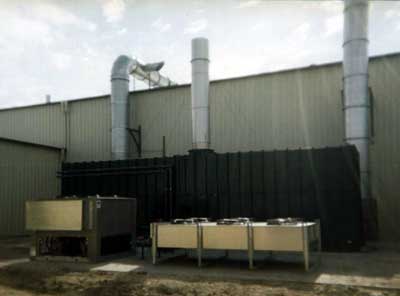 A company in a large metropolitan area of the Midwest was manufacturing steel tubes in various sizes for use in building steel support structures. Usually the steel structures would be visible after the building project was completed. Steel tubes have a tendency to rust rather quickly unless they are coated before being shipped to the job site. Applying oil to prevent rusting makes painting of the structure after it is erected difficult.
The manufacturer of steel tubes concluded that a resolution to its problem was to paint the steel tubes before they left its' facility. In order to make the process affordable, at the speed in which the tubes were produced, the coating used needed to be dry to the touch very quickly without cure in a heated oven.
By using the proper coating, the manufacturer would produce in excess of 100 tons of Volatile Organic Compounds per year. A control system therefore had to be installed that would reduce the emissions by at least 81% overall.
The affordable technology at the time was a thermal recuperative oxidizer that would incinerate the V.O.C.s emitted from the paint booth exhaust as well as the dryer section that used room air (which Controlled Environment Systems designed).
At this point Controlled Environment Systems introduced 100% capture (a permanent total enclosure). By definition the enclosure would collect all of the V.O.C.s produced and direct them to the oxidizers for incineration. CES designed and built enclosures for the three coating lines, which allowed 100% capture to be achieved. Since the spray coating operation involved particulates, a 3 stage filtration device was installed ahead of the regenerative oxidizer. The device raised the overall destruction efficiency to 99% and allowed production to increase even further while remaining within EPA permitting.
The company's production eventually reached three shifts, seven days per week. The electrical power and natural gas consumed by the oxidizers was exceeding $500,000 (U.S. dollars) per year.
To ameliorate the energy costs, CES then introduced a new incinerator technology—regenerative thermal oxidation. The thermal efficiency for this type of system is 95% and the pressure drop through the unit would be about half that of the existing units.
When the pipe manufacturer originally purchased it's existing systems, regenerative thermal oxidizers had not been an affordable technology. The situation had changed by 1995 and their existing unit needed repairs. After doing a cost comparison, it was clear that they should replace the existing units with the new technology.
With a new CES regenerative thermal oxidizer, the operating cost savings per year for a 35,000-scfm system would be $400,000. This Combined with the money saved by not doing the repairs, the company obtained a one-year payback.
About the author: David A. Swinehart is Vice-President of Engineering at Controlled Environment Systems ~ Telephone (262) 968-6565
SOURCE: Controlled Environment Equipment