
Mexico Print Plant Recycles its VOCs
Problem
With the advent of NAFTA, the industry in Mexico has come under increasing pressure to comply with environmental regulations. One of the industry's major package-printing players in Mexico, Grafo Regia SA de CV (Monterrey), decided in the mid-90s to proactively pursue the emission-control issue.
Grafo Regia found that most pollution-control processes, such as thermal/catalytic oxidation, although adequate to addressing pollution-control, are destructive, have no economic payback, and often require large inputs of energy. Grafo sought a process with a solvent-recovery system that would have economic payback.
Process and Provider Picked
Grafo Regia selected Amcec Inc of Lisle, IL because of its proven experience in solvent recovery and considerable experience with systems for gravure printing. For lack of space, the bulk of the solvent-recovery system was to locate on a reinforced section of the roof.
To simplify the printing and recovery processes and to maximize the economic payback, Grafo Regia decided to restrict its inks and coatings to the use of only two solvents (ethyl acetate and ethyl alcohol). (Toluene, a HAP, had to be eliminated for the recovered solvents to be reused for printing on food-related packaging.)
System
The solvent-recovery system comprises four adsorbers, of which three are on line at any given time while the other is being regenerated or on standby. Solvent laden air (SLA) capacity is 115,000 Nm3/hr (72,500 scfm) containing up to 350 kg/hr (775 lb/hr) of solvent vapors. (The available rooftop space is sufficient to accommodate one additional adsorber.)
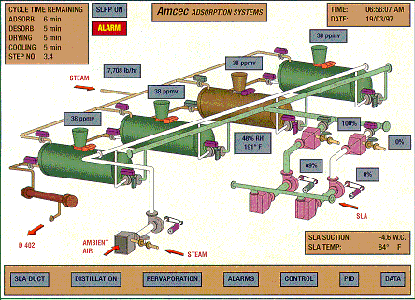
Adsorption. The SLA from the printing and laminating processes is filtered and cooled prior to entering the carbon adsorbers. A PLC controls the sequencing. A flame-ionization detector (FID), which continuously monitors the exhaust from the adsorber vessels, governs the adsorption cycle's duration.
When a predetermined exhaust concentration is detected (signaling carbon breakthrough), the analyzer initiates desorption of the next adsorber, while the adsorber that is idling advances to the adsorption mode. (The analyzer is backed by a preset timer in the PLC should breakthrough detection fail.)
Desorption. The adsorber that just completed its adsorption cycle is desorbed using saturated steam injected into the adsorber vessel counter-currently to the SLA flow through specially designed sparge pipes. The steam-and-solvent mixture goes through a vapor duct to a series of shell-and-tube heat exchangers for condensation and cooling.
A continuous decanter decants the condensed steam/solvent mixture, with the lighter solvent phase (essentially ethyl acetate with about 3.5% water) going to a "wet-solvent" tank. The aqueous phase (water containing some ethyl alcohol and ethyl acetate) collects in a 5000-gal weak-liquor tank.
Post Treatment
The steam/solvent mixture in the weak-liquor tank is treated with caustic to neutralize any acetic acid formed during the desorption process. The neutralized mixture goes to a steam-heated distillation column comprising both "stripping" and "rectifying" sections. The former strips the solvent from the solvent/water mixture; the latter enriches the vapor with a reflux stream of "overhead product"—the solvent mixture with a small percentage of water. Live steam injected at the bottom of the column provides the heat for the separation.
The "bottoms" of the column is clean water that discharges to the sewer while the overhead product condenses and collects in a receiver. A portion of this overhead product is used for "refluxing" the distillation column, with the balance going to the "wet-solvent" tank.
The "wet solvent," containing 7 to 8% water, goes to a vapor-permeation unit where it passes along a membrane that separates out the dry solvent for collection in a storage tank. The water permeate, containing a small percentage of solvent, is returned to the weak-liquor tank. The "dry solvent" consistently contains less than 1.0% water, suitable for reuse by the presses.
Outcome
The solvent-recovery system was commissioned in mid-1997 and is providing Grafo Regia with high-quality recovered solvent. The recovered solvent is expected to return Grafo Regia'a capital investment within five years while meeting its stringent pollution-control requirement.
About the authors: Vivek Nayak is engineering manager at AMCEC Inc. He has a bachelor's degree in chemical engineering, nearly a score years of experience in the field of adsorption, and a Professional Engineer certificate from the State of Illinois. Sergio Medrano is plant engineering manager of Grafo Regia, S.A. de CV and has a bachelor's degree in mechanical engineering. He has practiced at his position for about 20 years. Jaime Fermin is the environmental engineer of Grafo Regia, SA, de CV. He has a bachelor's degree in chemical engineering and industrial experience in the environmental field.