
Innovative technology used to remediate groundwater contamination at F.E. Warren AFB
By Frederick C. Heneman III and Michael R. May, P.E.
Contents
Remedial Action
Design
Construction
Monitoring Performance
The U.S. Environmental Protection Agency (EPA) estimates that there are approximately 5,000 U.S. Department of Defense, Department of Energy, and Superfund sites beset by environmental problems resulting from chlorinated solvent contamination in soil and groundwater. An effective method of dealing with the problem is the design and construction of a permeable reactive barrier (PRB) that uses the innovative EnviroMetal Technologies Inc. (ETI)-patented iron-filings technology to remediate groundwater contaminated with chlorinated hydrocarbons.
Some 40 PRBs have been constructed or are currently being designed worldwide. The largest Department of Defense continuous iron-filings PRB constructed to date is at the F.E. Warren Air Force Base (AFB) Spill Site 7 (SS7) in Cheyenne, WY. The PRB was designed and constructed for the Air Force Center for Environmental Excellence under the US Air Force Installation Restoration Program.
The contamination at SS7 originated from a grease trap in the southwest part of the site. Organic solvents, primarily trichloroethene (TCE), used as degreasers during liquid oxygen production, were discharged into the grease trap and ultimately drained to a surface drainage ditch leading north to Diamond Creek. In 1989, the grease trap and 15 feet of contaminated soil were excavated and removed from the site, but groundwater contamination was not addressed.
Remedial Action
A Record of Decision issued in 1997 specified remedial action for SS7 to treat volatile organic compounds (VOCs). Treatment involved a partially penetrating (hanging) iron-filings PRB to treat VOCs consisting of TCE, 1,2-dichloroethene, and vinyl chloride. The remedial action targeted the top 15 feet of the saturated zone and minimized contamination to the downgradient Diamond Creek.
The PRB, an in-situ, passive treatment wall, was intended to: 1) minimize the future residential population's potential for ingestion, inhalation, and dermal exposure to groundwater Indicator Contaminants of Concern (ICOC) by reducing contaminant concentrations to Maximum Contaminant Levels (MCLs) in the top 15 feet of groundwater; and 2) minimize contaminant loading to Diamond Creek from SS7 shallow groundwater by reducing groundwater contaminant levels to MCLs in the upper 15 feet of groundwater.

Data required for the PRB design included current soil and groundwater contaminant concentrations and distribution, aquifer hydraulic conductivity, hydraulic gradient, bulk density, porosity, and the reaction kinetics that determine the residence time required to reduce target groundwater contaminant concentrations to the proposed cleanup goals. An extensive pre-design investigation was conducted to address known design data gaps and the complex hydrogeology. These included soil characterization, monitor well installation, groundwater characterization, zero-valent iron characteristics, and column testing. (Back to top)
Design
The design required extensive site characterization, bench-scale treatability, and groundwater modeling. The PRB was divided into three segments to accommodate variations in hydraulic conditions and ICOC concentrations along the PRB alignment. The depth of the PRB was the same for all three segments, but its width and length varied between each segment based on different contaminant concentrations, saturated zone hydraulic conductives, and hydraulic gradients. The lengths and widths of each segment were established using the highest hydraulic conductivity and groundwater contaminant concentration encountered upgradient of the segment.
Potentiometric and TCE concentration maps were developed using groundwater flow patterns, hydraulic conductivity data, and site chemical data. The maps were used to calculate the width and identify the PRB location and alignment. The PRB iron flow-through thickness was determined from the anticipated groundwater velocity and residence time. The PRB was situated to intercept ICOC groundwater contamination migrating from the grease trap and reduce concentrations before groundwater made its way into surface waterways. The PRB was located as far downgradient in the plume as possible to maximize contaminant treatment but avoid construction constraints, such as a rare and endangered species protection area adjacent to the desired location, nearby groundwater collection trenches, and adjacent steep creek banks.
The intent of the Record of Decision was to address ICOCs in the upper 15 feet of groundwater. However, due to fluctuations of up to four feet in groundwater elevations near the PRB alignment, installation of a fixed location PRB would not always be adequate. In addition, iron is susceptible to oxidation if it is repeatedly exposed to wetting and drying. To minimize the potential for iron oxidation, the top elevation of the PRB was set at the historically low groundwater table elevation to keep the iron saturated. A low-permeability soil cap was designed on top of the iron to minimize groundwater flow over the PRB. The bottom of the PRB was 15 feet below the historically low groundwater level.
Laboratory bench-scale column tests were conducted by ETI to measure the effectiveness of iron technology for treating VOCs in the groundwater at SS7. The primary objective of the column testing was to determine the residence time required to degrade ICOCs to below MCLs. (Back to top)
Construction
The constructed PRB is 568 feet long with 15 vertical feet of iron below the historically low groundwater level. The minimum equivalent horizontal iron flow-through thickness is four feet in Segment 1, one foot in Segment 2, and 1.5 feet in Segment 3. Pure iron was used in Segment 1 and an iron/sand mixture in Segments 2 and 3. The SS7 PRB was completed in 1999 at a construction cost of approximately $2.35 million.
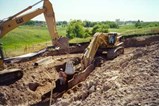
The PRB design identified several alternative construction techniques. The trench-box method was selected based on cost considerations, subsurface conditions, stringent requirements for tracking constructed PRB dimensions and the amount of iron used during construction, and heavy equipment requirements.
The trench box, which was fabricated specifically for the project, was 20 feet long, 20 feet high, and weighed approximately 50,000 pounds. It had six-inch-thick walls, an inside width of four feet, and tapered (knife) edges on its bottom and back. A total of 3.5 million pounds of iron were installed in the PRB. To allow construction of all three segments with the same trench box, an iron/sand mixture was produced to provide the equivalent pure iron thickness.
A construction quality assurance/quality control program was implemented and maintained during construction of the PRB. Standardized forms were developed and used to document shipments of iron, iron inspection upon delivery, individual iron super sack usage, and iron/sand mixing procedures. Iron/sand separation procedures were developed and conducted to assure uniformity of the mixture. The top and bottom elevations of the PRB were surveyed, and the weight of the iron placed was calculated with every five feet of PRB installation to confirm the amount of iron being placed. (Back to top)
Monitoring Performance
Soon after the PRB was installed near the end of 1999, a thorough, long-range performance monitoring program was developed to confirm that it was achieving its design and remedial action objectives. The system was left undisturbed for six months to allow conditions to equilibrate. The monitoring program was then implemented to determine whether the PRB is: reducing groundwater concentrations of contaminants of concern to below treatment goals; reducing contaminant loading to adjacent waterways; impacting adjacent waterways with byproducts of the remediation process; or affecting groundwater flow paths.
Contaminant concentrations from performance-monitor well samples in the iron and one to three feet downgradient of the iron reported VOC concentrations below detection limits and treatment goals. However, concentrations observed in monitor wells located 30 to 50 feet downgradient of the iron remain comparable to upgradient concentrations due, most likely, to desorption from contaminated aquifer materials. Elevated VOC concentrations detected below the PRB will continue to be monitored to determine if there is bypass beneath the PRB.
TCE concentrations in adjacent waterways are below treatment goals. Water quality parameters reported high pH, low Eh, and low dissolved oxygen concentrations in and downgradient of the PRB. Water-level measurements revealed a relatively flat and uniform hydraulic gradient across the PRB, indicating that the PRB is at least as permeable as the surrounding formation and, therefore, has not disrupted natural groundwater flow.
Monitoring results to date indicate that the PRB is operating as designed and reducing contaminant concentrations to treatment goals. (Back to top)
About the authors: Frederick C. Heneman III is project manager and Michael R. May, P.E., is project engineer for URS Corp. in Denver, CO. URS designed the PRB remediation system at F.E. Warren Air Force Base and provided construction oversight for the project. (Back)