
The Twin Bed-Retox Regenerative Incinerator Systems
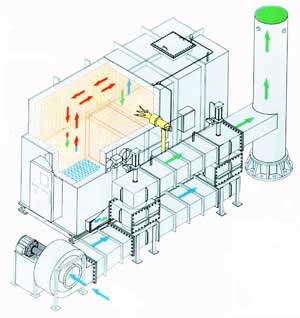 Controlled Environment Systems has been providing customers with quality-air pollution control systems for over 25 years but never before with such low operating costs to the customer. In the past, to meet stringent air quality control standards, manufacturers have relied on expensive methods of destroying VOCs (Volatile Organic Compounds) and odors. Catalytic and recuperative incinerators were thought to be the most effective methods of eliminating solvents from the air. Until just recently the high operating costs, continuous maintenance, and ineffectiveness of these units were just issues that companies had to deal with.
After exposure to the solvents, catalysts continually loose their effectiveness and need to be replaced on the catalytic units. On the recuperative units, metal heat exchangers due to their efficiencies consume large amounts of gas/btu per hour, when they aren?t breaking. Plus, both unit types use large horse powered centrifugal fans at high static pressures to push solvent laden air through the bed of the incinerator. Company?s profit margins were being greatly reduced to fix and maintain their air pollution control systems. Customers that have purchased a turnkey incineration system from CES have been pleasantly relieved of these unnecessary costs.
The twin bed-Retox? regenerative incinerator systems that CES installs have higher destruction efficiencies (99% and higher) without using any expensive catalysts or metal heat exchangers to replace. Regenerative units preheat the solvent laden air, utilizing a ceramic medium as the heat exchanger media. The unique aspect of this unit is that the heat exchanger is 95%(+) efficient which allows the unit to run without auxiliary fuel if the solvent laden air is 3% LEL or higher. The design of the heat exchanger on the unit allows for a very low profile and small footprint in comparison to most other units.
the Regenerative oxidizer systems, Air pollution control, VOC emission control, Cascading, ecirculation, 100% capture systems, Engineering design , installation, Hydrocarbon, destruction, Odor control, Catalytic , recuperative, Low operating costs, MACT, Standards, Thermal efficiency the
| CES Regenerative Unit (95% Thermal Efficiency) | Catalytic Unit (60% Thermal Efficiency) |
|
Air Flow |
10,000scfm |
10,000scfm |
Inlet Temperature |
80° F |
80° F |
Total btu/hr required |
858,000 btu/hr |
2,587,000 btu/hr |
Solvent Contribution @ 2%LEL |
611,000 btu/hr |
611,000 btu/hr |
Net btu/hr required |
247,000 btu/hr |
1,976,000 btu/hr |
Fuel costs- $0.35 per therm |
$0.86 / hr |
$6.92 / hr |
System Fan Horse Power |
32 hp |
50 hp |
System Fan kw |
24 kw |
37.5 kw |
System Electrical Cost @ $0.05/kw |
$1.20 / hr |
$1.88 / hr |
Total Operating Costs Per Hour For Utilities |
$2.06 / hr |
$8.80 / hr |
Total Utility Costs @ 3900 Hours Per Year |
$8,034 / year |
$34,320 / year |
Catalyst Replacement Costs- Based On An Average Catalyst Life Of 5 Years |
- |
$10,000 |
TOTAL-ONE YEAR OF OPERATION |
$8,034 |
$44,320 |
SOURCE: Controlled Environment Equipment